

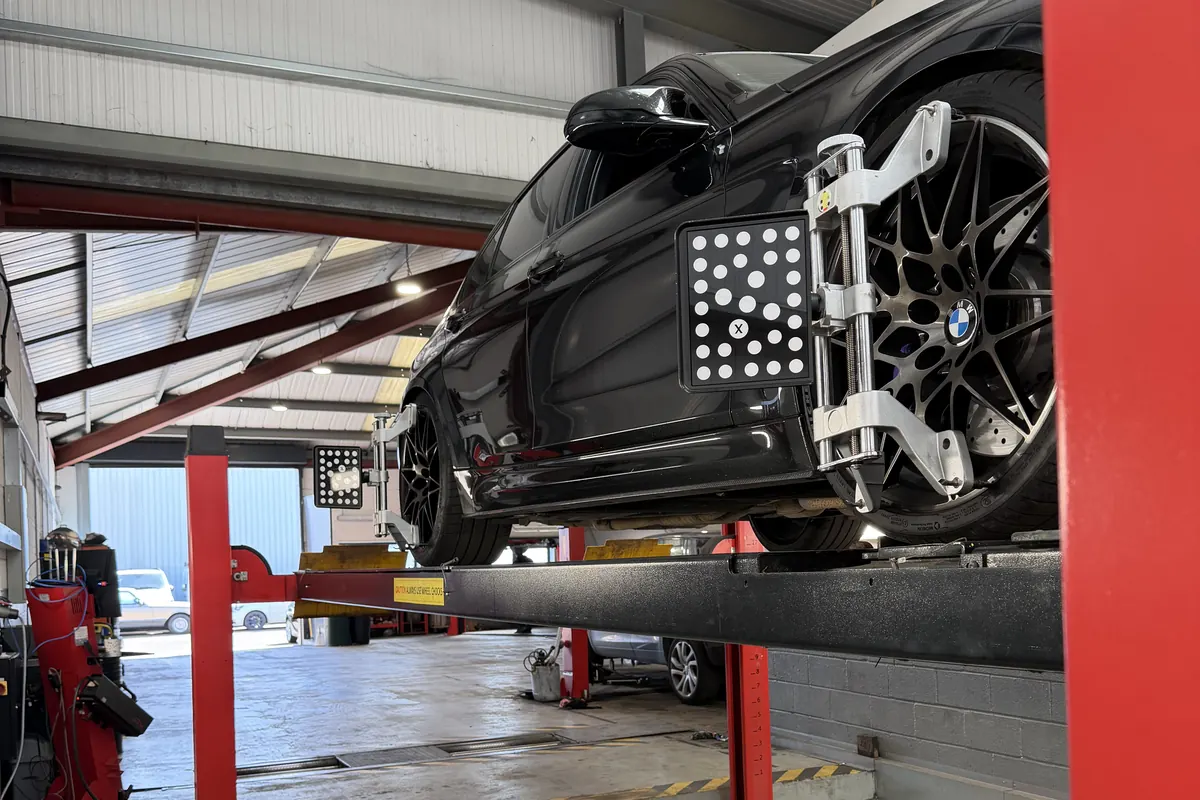
4 Wheel Alignment in Whitstable & Canterbury
Precise four-wheel laser alignment to manufacturer specification. Correct uneven tyre wear, improve handling and protect your suspension — on all makes and models, from daily drivers to performance vehicles.
What is wheel alignment and why does it matter?
Wheel alignment — sometimes called tracking — is the process of adjusting the angles at which your wheels sit relative to the vehicle and to each other. Three measurements are involved: toe (whether the wheels point inward or outward), camber (whether they lean in or out when viewed from the front), and caster (the angle of the steering axis). All three affect how the vehicle handles, how evenly the tyres wear, and how much fuel it uses.
When alignment is correct, the vehicle drives straight with no pull, the steering wheel sits centred, and the tyres wear evenly across the full tread width. When it’s out, you’ll feel it: the car pulls to one side, the steering feels vague or off-centre, and you’ll start seeing uneven or accelerated wear on one or more tyres.
Most garages in the Whitstable area only offer 2-wheel (front-axle) alignment. At NMD, we carry out full 4-wheel alignment — measuring and adjusting all four corners of the vehicle. This matters because the rear axle geometry affects front alignment, and on many modern cars, the rear is adjustable. Aligning only the front without checking the rear means you’re working to potentially incorrect reference points.
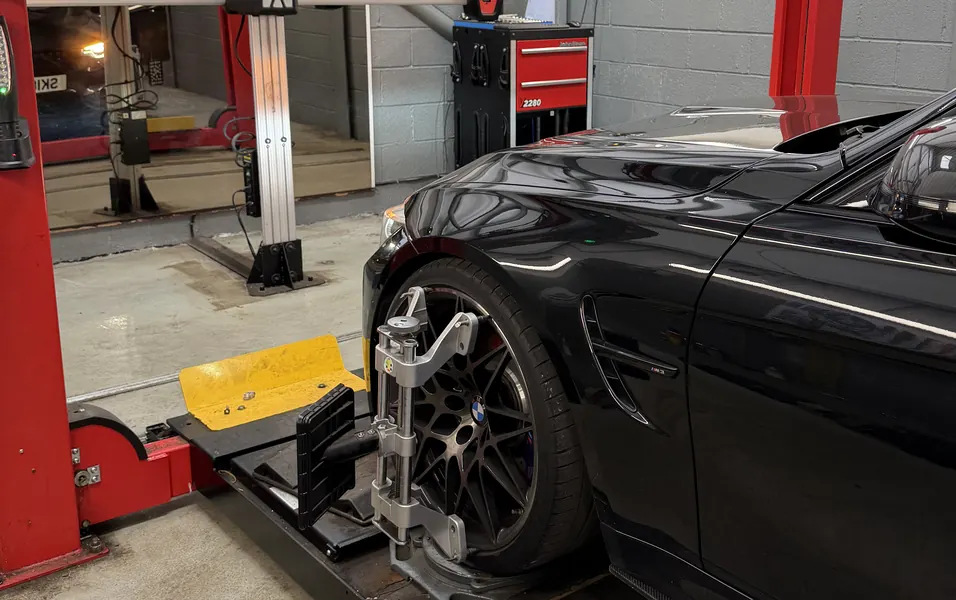
Signs your alignment needs checking
Some of these are obvious the moment they appear. Others develop gradually — by the time you notice, you may already have unnecessary tyre wear. If any of these sound familiar, it’s worth having the alignment checked before replacing tyres, otherwise the new rubber will wear the same way.
Pulling to one side
The vehicle drifts left or right on a straight, flat road without input from the steering wheel. One of the most common alignment symptoms.
Off-centre steering wheel
The steering wheel sits at an angle when driving straight. The wheels may be pointing correctly, but the steering column position is out of sync with the alignment.
Uneven tyre wear
One edge of a tyre wearing faster than the other — inner edge, outer edge, or feathered wear across the tread. Often first noticed during a service or tyre change.
Tyres wearing too fast
Tyres that should last 20,000+ miles wearing out in half the distance. Misalignment forces the rubber to scrub against the road rather than rolling cleanly.
Vague or loose steering
The car doesn’t respond as crisply as it used to, particularly at motorway speed. It may feel like the steering has too much play or isn’t as connected.
After hitting a pothole or kerb
A hard impact can shift alignment immediately. Kent’s roads aren’t getting any smoother — if you’ve hit something solid, it’s worth checking the geometry.
Why 4-wheel alignment, not just front tracking?
Traditional “tracking” adjusts only the front wheels — measuring toe and setting it to a nominal value. That was adequate on older vehicles with solid rear axles and no rear adjustment. On most modern cars, it’s not enough.
Modern vehicles have independent rear suspension with geometry that can shift over time. If the rear axle isn’t sitting square, the front alignment is being set against a skewed reference line. The result: the steering wheel sits off-centre, the vehicle crab-walks, and tyre wear develops even though the front “tracking” numbers look correct on paper.
Full 4-wheel alignment measures all four corners simultaneously. We check toe, camber and caster on the front axle, and toe and camber on the rear. Adjustments are made to bring the entire vehicle back to the manufacturer’s specified geometry — not just the front wheels to a generic number.
This is particularly important on performance vehicles, lowered cars, and vehicles with aftermarket suspension, where even small deviations from spec can cause noticeable handling issues and rapid tyre wear.
What happens during a 4-wheel alignment at NMD
The process takes around 45 minutes to an hour depending on the vehicle and how much adjustment is needed.
Tyre and suspension check
Before touching the alignment, we check tyre condition, pressures, and inspect the suspension for worn components. There’s no point aligning a vehicle with a worn track rod end — the geometry won’t hold. If we find anything, we’ll let you know before proceeding.
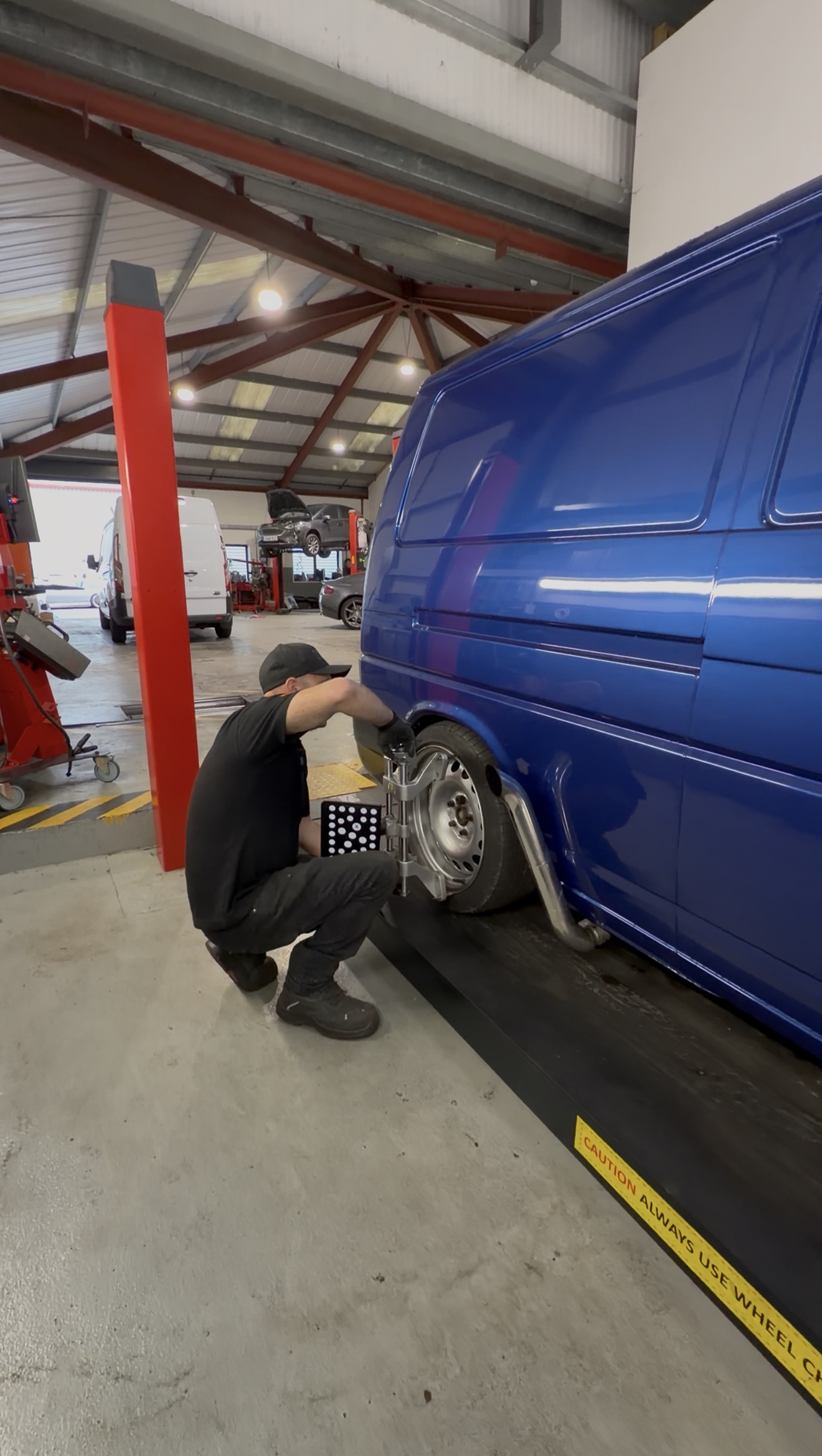
Mount alignment targets
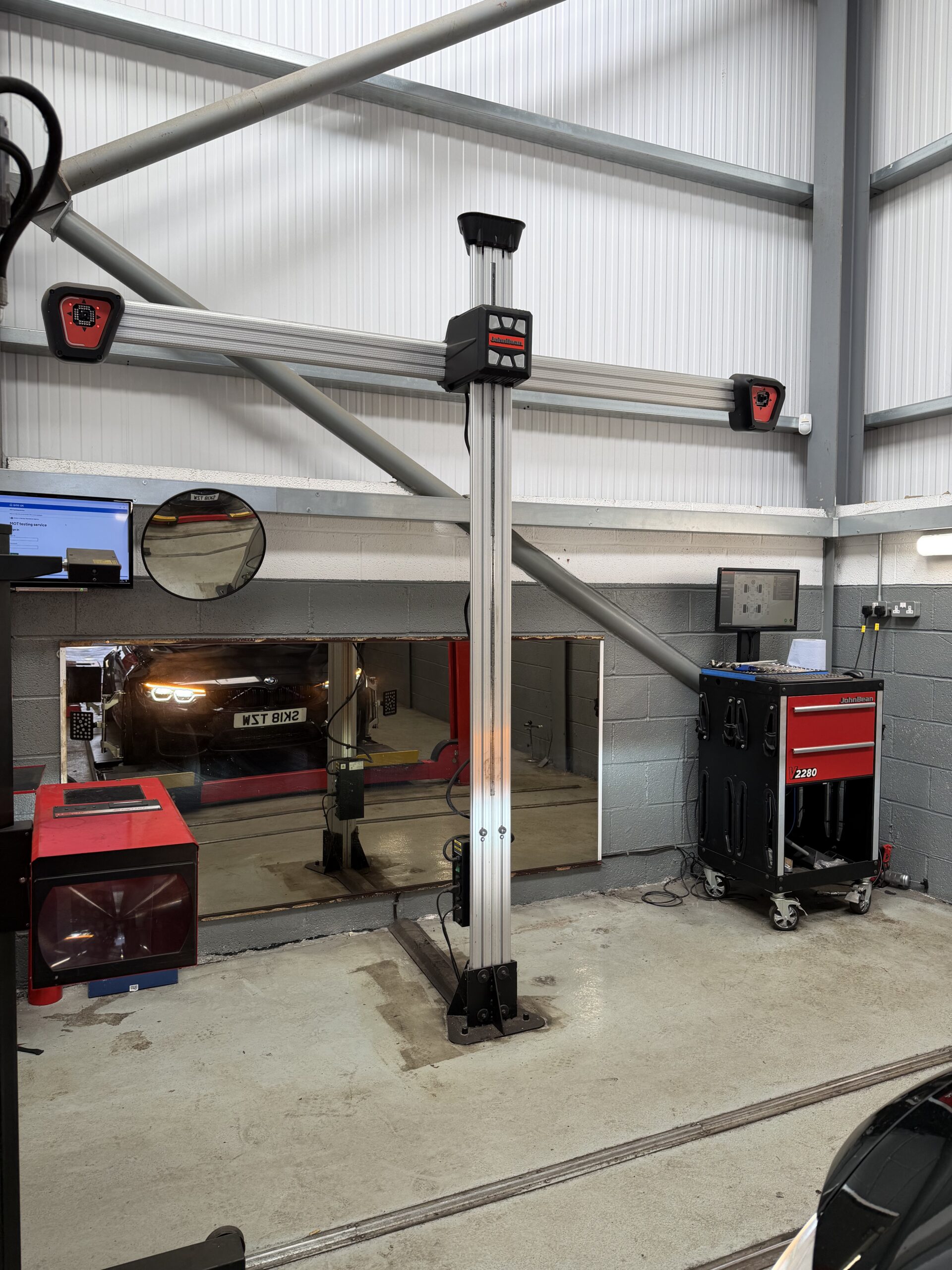
Precision alignment targets are clamped to each wheel. These communicate with the alignment system to measure the exact position of all four wheels relative to each other and to the vehicle’s centreline.
Measure current geometry
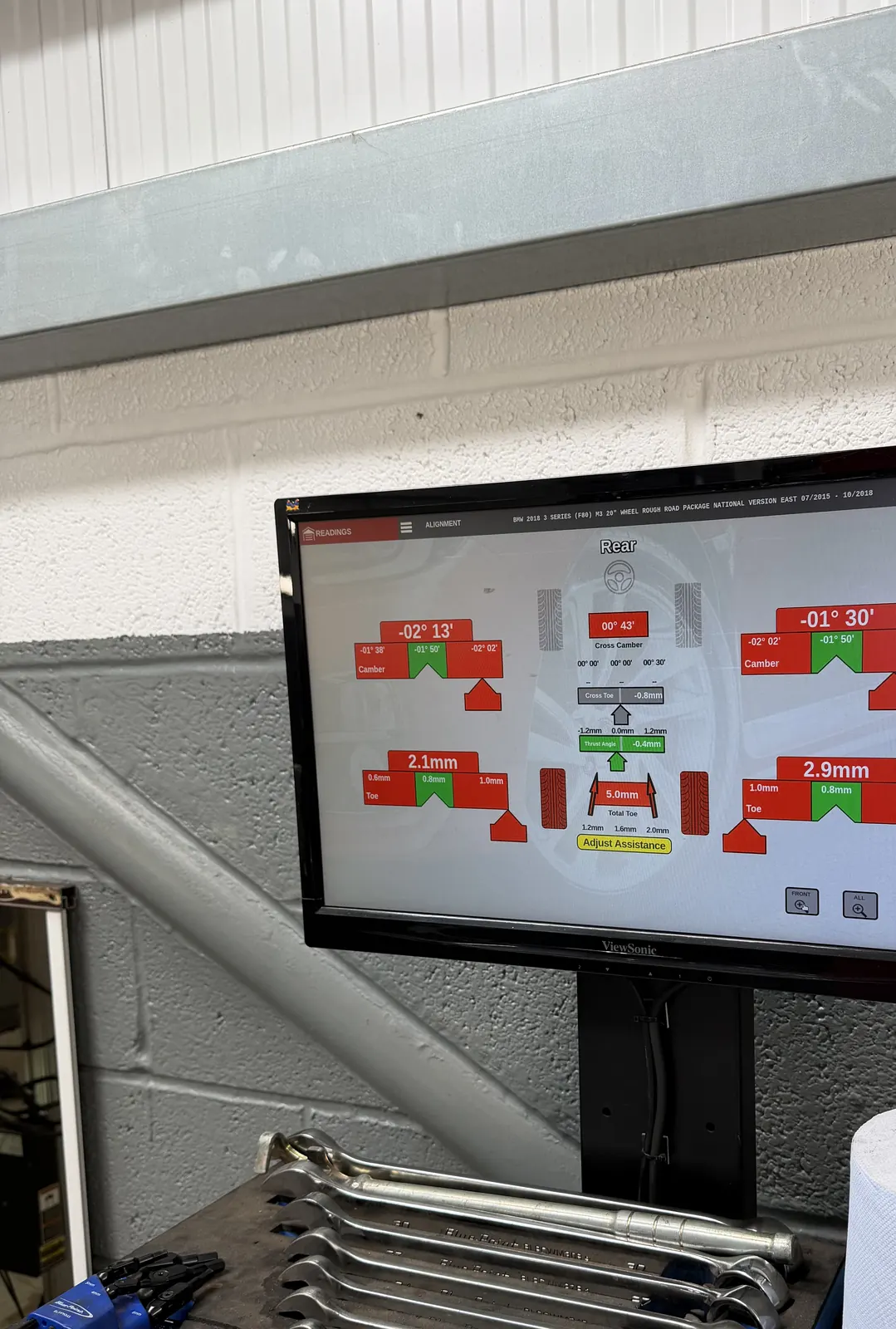
The system reads the current toe, camber and caster values on all four wheels and compares them against the manufacturer’s specifications for your exact vehicle. Red values are out of spec, green values are within tolerance.
Adjust to specification
We adjust all available angles to bring every wheel within the manufacturer’s specified range. Front toe and camber first (using the rear as reference), then rear toe and camber where adjustable. The steering wheel is centred as part of the process.
Verify and print
Final readings are taken and verified. We print a before-and-after report showing exactly what was out and what it’s been set to. You keep this for your records.
Road test
A short road test confirms the vehicle tracks straight, the steering wheel sits centred, and the handling feels correct. If anything needs fine-tuning, we adjust it before you collect.
When should you get your alignment checked?
There’s no fixed service interval for wheel alignment in most manufacturer schedules, which means it often gets overlooked until there’s an obvious problem. As a practical guide, we’d suggest checking it in these situations:
After fitting new tyres
Starting with fresh rubber on misaligned wheels means the new tyres will begin wearing unevenly from day one. If you’re spending money on tyres, it makes sense to protect that investment with a quick alignment check.
After suspension work
Replacing shock absorbers, springs, drop links, track rod ends, control arms, or any other suspension or steering component can alter the geometry. Alignment should always be checked after this type of work.
After hitting a pothole or kerb
A solid impact — even one that doesn’t cause visible damage — can knock alignment out. If the steering feels different after a hit, get it checked sooner rather than later.
Annually, or every 10,000–12,000 miles
Even without a specific event, alignment drifts naturally over time as suspension components settle and wear. An annual check is a sensible preventative measure, particularly on East Kent’s road surfaces.
If you’ve lowered or modified the vehicle
Any change to ride height — lowering springs, coilovers, spacers — changes the suspension geometry and requires realignment. Performance vehicles and track cars often need alignment set to tighter tolerances than a standard road car.
Vehicles we align
We carry out 4-wheel alignment on all makes and models — from daily-driven hatchbacks to performance cars and light commercial vehicles. Our alignment system holds manufacturer specifications for virtually every vehicle on the road, so we’re setting your car to the correct numbers for your exact make, model and year — not a generic setting.
We work particularly often with:
BMW — 1 Series, 2 Series, 3 Series, 4 Series, 5 Series, X1, X3, X5, M Sport and M cars. BMW owners often notice alignment issues more quickly because the steering is sharp and any deviation is felt immediately.
Mercedes — A-Class, C-Class, E-Class, GLC, GLE. Airmatic and conventional suspension variants.
Volkswagen / Audi — Golf, Polo, Tiguan, A3, A4, Q5. Common after spring changes and on lowered vehicles.
Ford — Fiesta, Focus, Puma, Kuga, Transit, Ranger. Including ST and RS performance models.
All other makes — Peugeot, Citroën, Vauxhall, Jaguar, Land Rover, Toyota, Honda, Hyundai, Kia, SEAT, Škoda, Volvo and anything else you drive.
Common questions about wheel alignment
How much does 4-wheel alignment cost?
How long does wheel alignment take?
What’s the difference between tracking and wheel alignment?
Do I need alignment after fitting new tyres?
Can you align lowered or modified vehicles?
Will alignment fix my car pulling to one side?
Do you offer 2-wheel alignment as well?
Related services
We carry out 4-wheel alignment for customers across East Kent, including Whitstable, Canterbury, Herne Bay, Faversham, Tankerton, Seasalter, Blean, Sturry, Chartham, Hernhill, Boughton and surrounding areas.